VapoFil Official Website › Blog › Every amount printed
Every Amount Printed: Reading a Supplement Panel With No Proprietary Blend
Many supplements in this category hide their formula inside a proprietary blend: one total weight, a list of names, and no amount for any of them. The VapoFil panel does the opposite. It prints a milligram figure beside all seven actives, 118 mg a serving in all. This post explains what the labelling rule allows, how to read each line of this panel, and what a fully printed label lets a buyer do.
- A proprietary blend only has to declare its total weight; the amount of each ingredient inside it can stay private.
- The VapoFil panel prints an amount on every line: five at 20 mg, tongkat ali at 10 mg and horny goat weed at 8 mg, 118 mg per two-capsule serving.
- Both concentrated extracts also print their ratio and a dry-herb equivalent, so the starting material is on the label too.
- Printed amounts are what make a label checkable: against the research, against other bottles, and in a conversation about what you take.
What a proprietary blend is, and what it keeps back
In the United States the layout of a Supplement Facts panel is set by the federal rule for supplement labels, 21 CFR 101.36. Ingredients without a Daily Value, which covers almost every herb, have to be listed with an amount per serving. There is one exception, and it is widely used: the proprietary blend.
Under that exception a maker can group ingredients under a blend name, print the combined weight of the blend, and list the ingredients inside it in descending order of weight. The rule does not require the amount of each ingredient in the blend. A 500 mg blend of five herbs could be 496 mg of the cheapest one and a trace of the other four, and the label would still be lawful.
- What a blend label tells you: the names, their order by weight, and the total.
- What it keeps back: the amount of any single ingredient, and so whether any of them is present at a meaningful level.
- What a fully printed label tells you: all of the above, plus a figure for every line.
Makers use blends to protect a formula from copying, and that is a fair commercial reason. For a buyer, though, the difference is practical. A printed figure can be looked up, compared and discussed; a name inside a blend cannot. VapoFil takes the printed route on every line.
The VapoFil panel, line by line
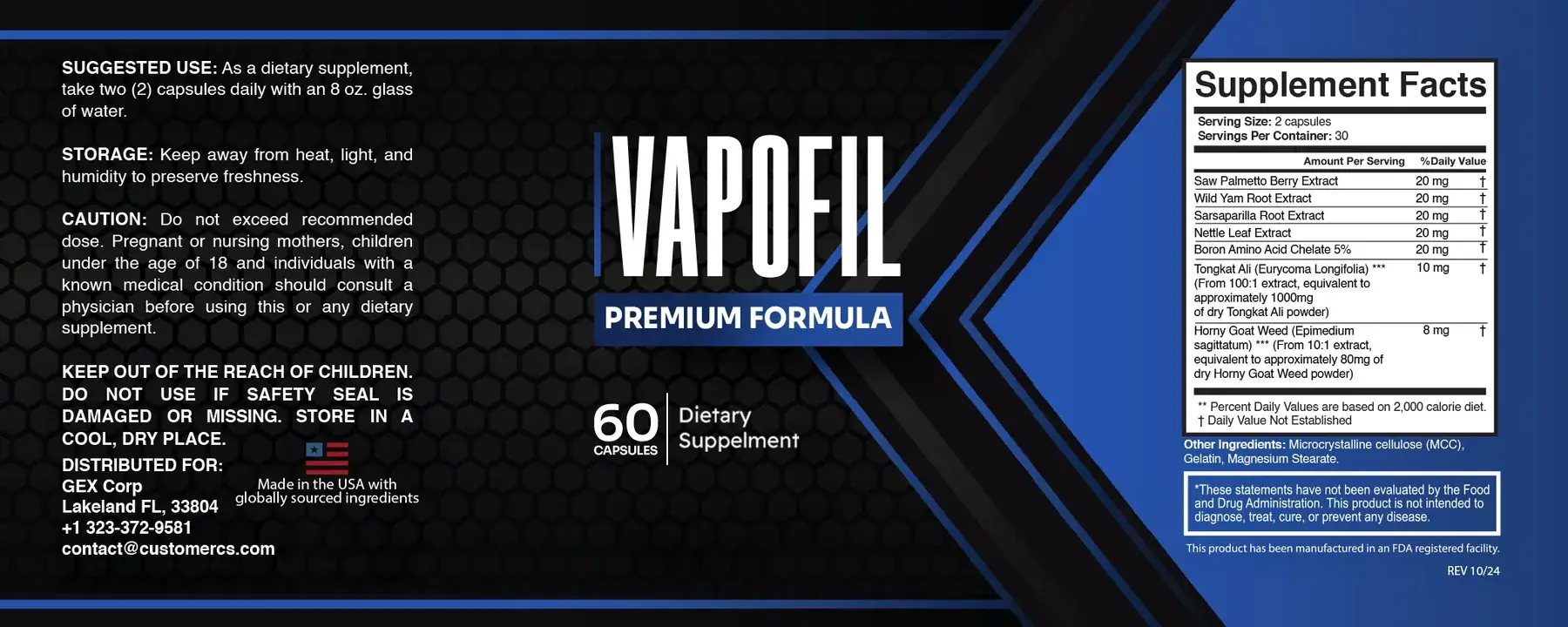
The panel sits on the right of the label, under the heading Supplement Facts. The serving size is two capsules and a bottle holds 30 servings, so every figure below is the total for one two-capsule serving. Here is each line as printed, with what it tells you:
| Panel line | Per serving | What the line tells you |
|---|---|---|
| Saw palmetto berry extract | 20 mg | Berry extract; the plant part is named |
| Wild yam root extract | 20 mg | Root extract; the plant part is named |
| Sarsaparilla root extract | 20 mg | Root extract; the plant part is named |
| Nettle leaf extract | 20 mg | Leaf extract; the leaf, not the root |
| Boron amino acid chelate 5% | 20 mg | The chelate weight; 5% of it, 1 mg, is elemental boron |
| Tongkat ali (Eurycoma longifolia) | 10 mg | A 100:1 extract, equivalent to about 1,000 mg of dry root powder |
| Horny goat weed (Epimedium sagittatum) | 8 mg | A 10:1 extract, equivalent to about 80 mg of dry herb powder |
Seven lines, 118 mg of actives per two-capsule serving. Every line carries the dagger that points to ‘Daily Value not established’.
Two details are worth noticing. Each botanical names its plant part, berry, root or leaf, which the labelling rule asks for and which matters because different parts of one plant are different preparations. And the seven figures add up: five lines of 20 mg, one of 10 mg and one of 8 mg make exactly 118 mg, with nothing held back in a blend total.
Reading the two extract lines
Two lines are concentrated extracts, and the panel prints three facts for each. For tongkat ali: 10 mg of extract, a 100:1 ratio, and a note that this is equivalent to approximately 1,000 mg of dry tongkat ali powder. For horny goat weed: 8 mg of extract, a 10:1 ratio, equivalent to approximately 80 mg of dry powder.
The ratio describes how much starting herb went into each unit of finished extract. The rule gives makers room to describe an extract this way, and some labels print only the equivalent, which is the larger and more flattering number. Printing the extract weight beside it, as this panel does, gives the reader both figures and leaves the interpretation to them.
- Extract weight is what is physically in the capsule.
- Ratio is how concentrated it is compared with the dried herb.
- Dry-herb equivalent is how much starting material it came from, not an extra amount on top.
VapoFil: seven actives, every amount printed
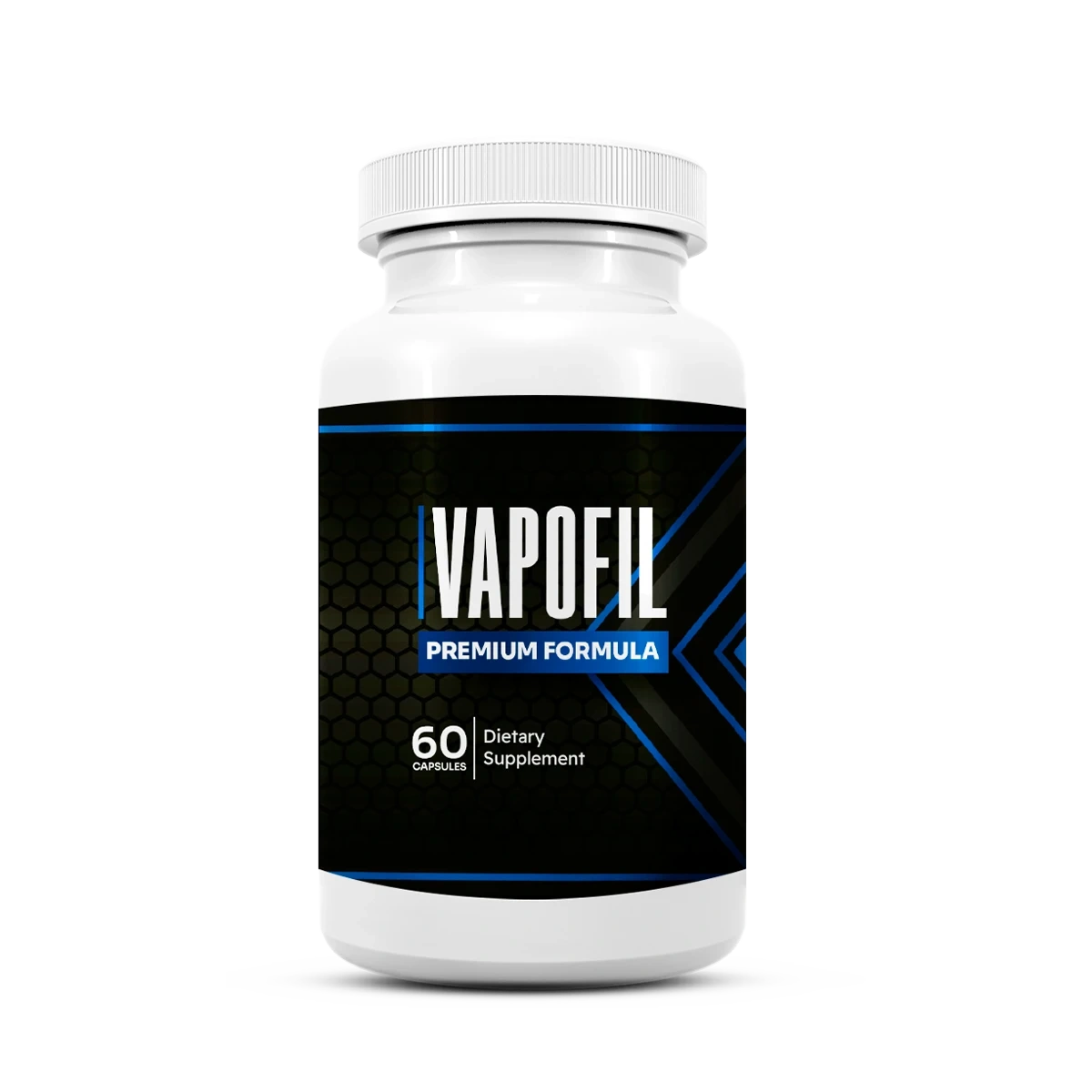
Two capsules a day with water, 118 mg a serving with no proprietary blend, and a 60-day money-back guarantee from the date of purchase.
From $49 a bottle on six · one bottle $89 · 60-day money-back guarantee
Order VapoFil On The Official WebsiteTwo capsules a day · 60 per bottle · lot VAP-26/GO-5862
The dagger, the other ingredients and the small print
Below the seven actives the panel prints its footnotes. The dagger on every line refers to ‘Daily Value not established’, the statement the rule requires for ingredients with no reference intake. It does not mean an amount is missing; it means there is no government daily figure to express it as a percentage.
Under the panel come the other ingredients: microcrystalline cellulose, a plant-fibre filler; gelatin, the capsule shell; and magnesium stearate, a flow aid that keeps powder moving through the capsule machine. Nothing sweet, no colour and no flavouring is listed. The facility line, “This product has been manufactured in an FDA registered facility.”, and the revision mark REV 10/24 complete the panel side.
What printed amounts let you do
A printed figure is useful in three concrete ways. The first is research. Published trials report the dose they gave, and a printed amount can be set beside it. An evidence review of ingredients in popular male supplements worked through products ingredient by ingredient in exactly this way, which is only possible when the amounts are on the label. The VapoFil ingredients page does the same for each of the seven lines.
The second is comparison. Two bottles with the same seven names can be very different products. With amounts printed on both, the comparison takes a minute; with a blend on either side, it cannot be made at all.
The third is conversation. NCCIH’s guidance on supplements asks people to tell their health care providers about everything they take, and the Office of Dietary Supplements consumer guide explains why a label, not a word on the front of a pack, is the document that counts. A panel with every figure printed can be shown as it is.
A five-minute panel check for any bottle
The same few minutes of reading work on any bottle in this category. Five checks cover most of what a panel can tell you:
Find the serving size
Capsules per serving and servings per bottle come first, because every figure on the panel is per serving.
Look for the word blend
If a group of ingredients sits under one total, note which names are inside it: their individual amounts are not stated.
Read each plant part
Root, leaf, berry or seed. A different part of the same plant is a different preparation.
Read the extract lines twice
Extract weight, ratio and dry-herb equivalent are three different numbers; know which one you are looking at.
Finish with the other ingredients
The shell, the filler and anything added for colour or flavour, which matters for diets and allergies.
Run on VapoFil, the check comes back clean on the first four: two capsules a serving, no blend, every plant part named, both extracts printed three ways. The fifth shows a gelatin shell, worth knowing if you avoid animal products. The full panel, with every footnote written out, is on the Supplement Facts page.
What a fully printed label is worth
A fully printed panel is not a promise about results, and no trial of the finished VapoFil capsule has been published. What it offers is something simpler and rarer in this category: nothing on the label has to be taken on trust. Every figure is there to read, check and compare.
The four supports the seller names are set out on the benefits page, the routine on the how to use page, and the three packs on pricing.
VapoFil is a dietary supplement, not a treatment for erectile dysfunction or any other condition. A lasting change in erections or desire can be an early sign of something that needs a check-up: an umbrella review of the research found erectile dysfunction consistently linked with later heart disease, and MedlinePlus lists the other causes worth ruling out, medicines among them. That is a reason to see a clinician first, not a reason to start a capsule.
References
- Kuchakulla M, Narasimman M, Soni Y, et al. A systematic review and evidence-based analysis of ingredients in popular male testosterone and erectile dysfunction supplements. Int J Impot Res. 2021;33(3):311-317. PMID 32358510. https://pubmed.ncbi.nlm.nih.gov/32358510/
- Code of Federal Regulations, Title 21, Section 101.36: Nutrition labeling of dietary supplements. Legal Information Institute, Cornell Law School. https://www.law.cornell.edu/cfr/text/21/101.36
- NIH Office of Dietary Supplements. Dietary Supplements: What You Need to Know. https://ods.od.nih.gov/factsheets/WYNTK-Consumer/
- National Center for Complementary and Integrative Health. Dietary and Herbal Supplements. https://www.nccih.nih.gov/health/dietary-and-herbal-supplements